Study shows AI can be safely deployed in NHS prostate cancer diagnosis
15 July 2026
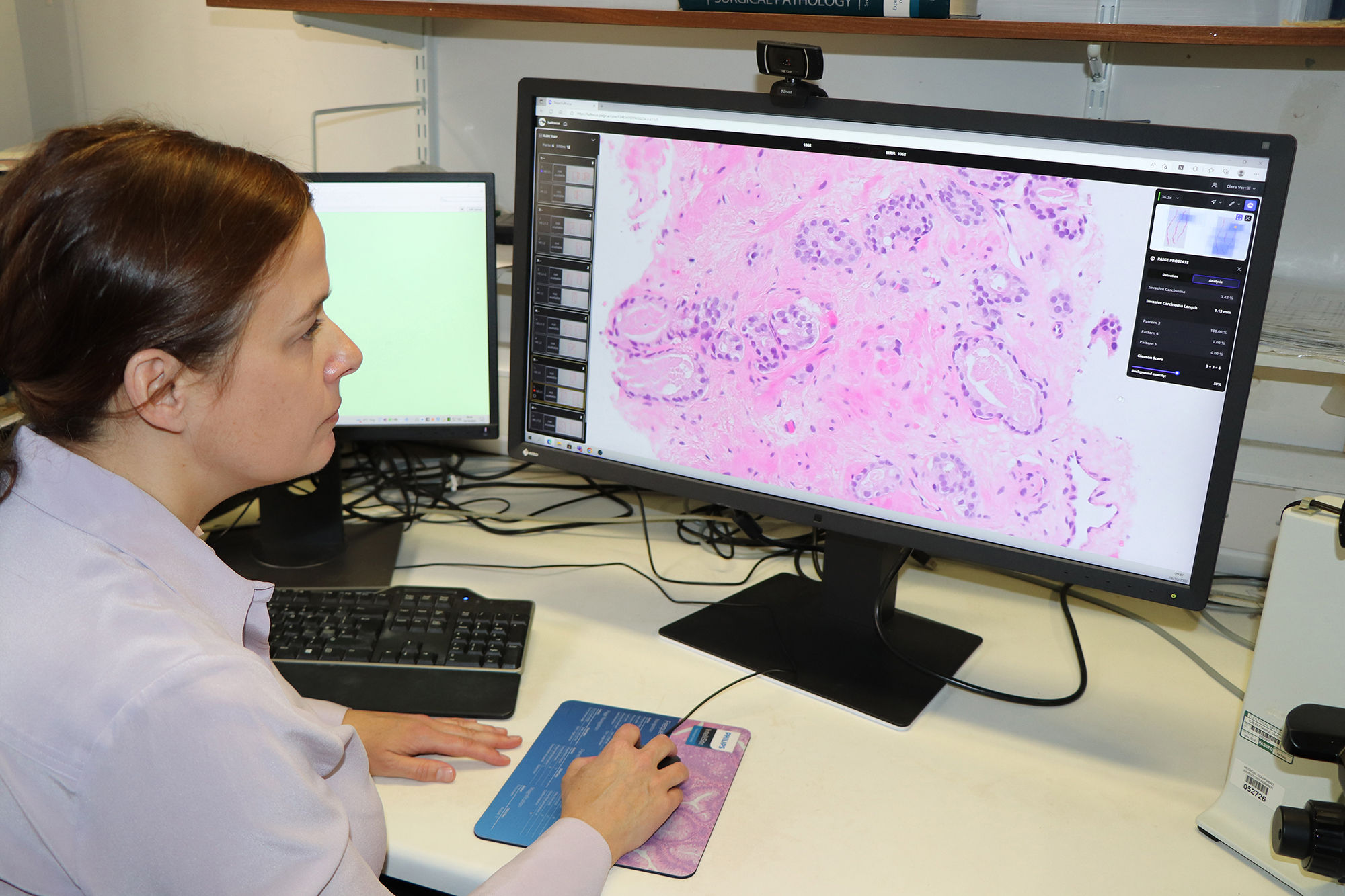
Professor Clare Verrill uses the AI pathology software
A landmark study has shown that artificial intelligence can safely be used in NHS histopathology laboratories and demonstrated its potential to improve and standardise prostate cancer diagnosis.
The Articulate Pro study is one of the first examples of real-time use of AI technology in NHS histopathology practice. Its findings, published in NPJ Digital Medicine, provide new evidence that AI can be safely and effectively incorporated within routine diagnostic workflows.
The project was led Professor Clare Verrill, Oxford University Hospitals Cellular Pathology Consultant and Professor of Cellular Pathology and Artificial Intelligence at the University of Oxford’s Nuffield Department of Surgical Sciences.
She said: “This study provides vital evidence that we can safely and effectively roll out AI technology to help improve prostate cancer diagnosis in the NHS, working alongside expert histopathologists. This helps realise the vision of digitally enabled healthcare for all, which will pave the way for large-scale uptake across the NHS.”
The technology, Paige Prostate, was evaluated in the prostate cancer biopsy pathway across three NHS trusts in the UK. The aim was to assess whether the AI diagnostic system could support more consistent and accurate diagnosis.
The Paige Prostate Suite is a group of AI-powered applications designed to aid in the detection and grading of prostate cancer on routine stained images of prostate needle biopsies. The study examined how using the Paige Prostate Suite affected pathologists’ clinical decision-making, pathology service delivery and the use of resources in real-world NHS settings.
The study was delivered by a multi-disciplinary team, and the technology was rolled out for evaluation at Oxford University Hospitals NHS Foundation Trust, North Bristol NHS Trust, and University Hospitals Coventry and Warwickshire NHS Trust.
More than 1,000 men’s prostate biopsies were assessed in real time, with AI used alongside expert histopathologists.
The study demonstrated that the technology could be safely deployed in NHS IT systems. It identified areas suspected of being cancerous that were difficult to spot or prompted an amended grade in the aggressiveness of the tumour. In a small number of cases, this led to different clinical management options being offered.
The technology was associated with a quicker reporting of results at some centres, meaning patients could potentially receive results a day sooner. There was also a reduction in immunohistochemistry (IHC) request – additional staining and laboratory tests, which could consequently benefit overstretched NHS labs by reducing workflow and generating cost savings.
Individuals with lived experience of prostate cancer contributed at every stage, and three members of the public served on the Project Management Board.
The study was funded and overseen by the Department of Health and Social Care (DHSC), in collaboration with the National Institute for Health and Care Research (NIHR) and the Accelerated Access Collaborative (AAC), through the Artificial Intelligence in Health and Care Awards.