Staying safe in hot temperatures
06 July 2026

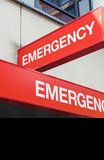
Temperatures are set to rise again this week, and we’re asking you to take care and help us keep our Emergency Departments for emergencies.
The main risks posed by hot weather are:
• Dehydration from not drinking enough water
• Overheating, which can make symptoms worse for people who already have problems with their heart or breathing or long-term health conditions
• Heat exhaustion and heatstroke.
Higher temperatures also mean more people spending time near water, but open water can be dangerous – even for strong swimmers. Rivers, lakes, canals, quarries, and reservoirs can be much colder than they look, with hidden hazards and strong currents.
Oxfordshire County Council’s Fire and Rescue Service has some advice on staying safe in water – you can read more on their website.
Family Information Service | Water safety advice
Felicity Taylor-Drewe, Chief Operating Officer at OUH, said: "Very hot temperatures are now becoming increasingly regular across the UK, and we’re asking people to take care and look after themselves in the heat.
“Taking a few simple steps can make a big difference – make sure you’re drinking enough water, using sunscreen, and where possible avoiding strenuous activity when the day is at its hottest.
“In some cases, heat-related conditions can make people really unwell and lead to admissions to hospital. Help us to keep our Emergency Departments for genuine emergencies, and take care of yourself and those around you in the heat.”
There are many options available to you to help stay well.
Emergency Departments (A&E) and 999
Emergency Departments and 999 are for life-threatening emergencies. If you come to an Emergency Department (A&E) for other conditions, you may face a very long wait as priority is given to patients with the most urgent clinical need.
NHS 111
If you need clinical advice but are not in a life-threatening emergency, contact NHS 111 online or call for free. Fully trained advisers are available 24 hours a day, every day.
They will ask questions to assess your symptoms and provide healthcare advice or direct you to the right local service, or call an ambulance if necessary.
Get help for your symptoms - NHS 111
Pharmacies
Pharmacies provide advice on minor illnesses and conditions, and advice on how to manage your medications.
You can also order a repeat prescription via the NHS App. There is more information about how to get the app on the NHS website. Once set up, prescriptions can be sent to a high street pharmacy for collection or delivery if available.
Healthier Together app and website
The Healthier Together website is designed to help parents and guardians of young children, and there is an app too - it has features like being able to create a secure profile for your child, as well as easily check their symptoms if they're unwell and get advice on what to do and where to go next.
There is a lot of helpful information on the Healthier Together website, and you can download the app there too.
Oxfordshire Healthier Together
Minor Injuries Unit
If you need prompt advice or treatment for minor injuries, a Minor Injuries Unit (MIU) could help you. You can get treatment at an MIU for deep cuts, eye injuries, broken bones, severe sprains, minor head injuries, minor burns or scalds, minor sports injuries.
Oxfordshire MIUs are located at Abingdon Community Hospital, Townlands Memorial Hospital in Henley, and Witney Community Hospital.
Minor Injury and First Aid Units
Self-care
Self-care is the best choice to treat very minor illnesses and injuries. A range of common illnesses and injuries can be treated at home simply by combining a well-stocked medicine cabinet with plenty of rest.
For information to help you self-care, including healthy lifestyle information, a health A-Z of conditions and treatments, or to find your nearest pharmacy for over-the-counter medicines, visit the NHS website.
Heatwave: how to cope in hot weather - NHS
NHS website for England - NHS