Piped anaesthetic gas phased out to cut carbon
25 June 2026
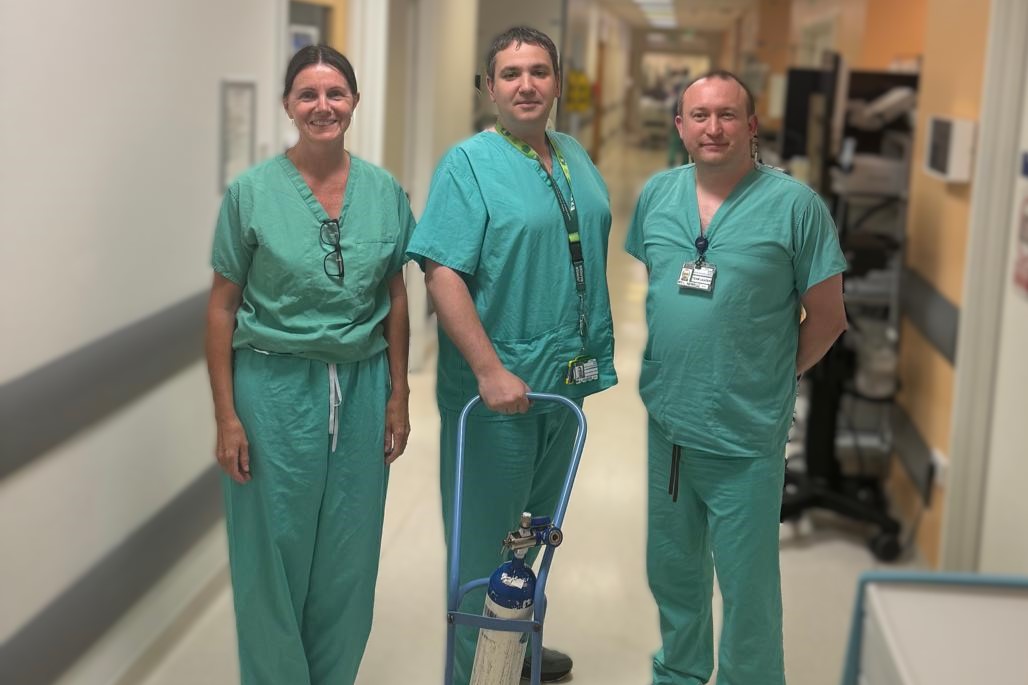
The team that led the change in the West Wing theatres at the John Radcliffe Hospital
Simple, pragmatic changes to the delivery of nitrous oxide (N2O) at all four hospitals run by Oxford University Hospitals (OUH) have led to a cut in greenhouse gas emissions.
The John Radcliffe Hospital, Churchill Hospital and Nuffield Orthopaedic Centre in Oxford and the Horton General Hospital in Banbury have switched from delivering N2O via a manifold system – which supplies gas through pipelines across hospital sites – to using portable supplies delivered in small cylinders.
The change is collectively saving an estimated 721 tonnes of carbon dioxide equivalent (CO2e) each year.
That is the same as driving two million miles in an average UK petrol car – or 86 times around the Earth.
This major change across all OUH hospital sites removes the need for large-scale distribution systems and supports a more sustainable approach to using anaesthetic gases.
N2O is used occasionally by anaesthetists but comes with a significant environmental cost.
Using cylinders that attach directly to anaesthetic machines instead of travelling through long pipelines improves efficiency, reduces the risk of leaks, and means staff don’t need to spent time maintaining and repairing the system. Audits across UK hospitals have shown that manifold systems can be wasteful.
N2O is now delivered to patients on an individual basis and, as a result, much smaller amounts of the gas are kept on site, saving space too.
Dr Søren Kudsk-Iversen, an Anaesthetic Consultant and Anaesthetic Sustainability Lead at OUH, has worked with clinical teams on each site to introduce the less wasteful cylinders, with the Horton General the first hospital to stop using the pipe-based system in 2024.
Søren said: "Without compromising patient care, and with incredible and positive engagement from a wide range of staff across all sites, we are seeing a huge and measurable reduction in our carbon footprint, supporting progress towards targets.
"This has only been possible due to the persistence of dedicated colleagues and the kind support of the Greener NHS Nitrous Waste Mitigation Team."
Lisa Hofen, Chief Estates and Facilities Officer with responsibility for sustainability at OUH, said: "Moving all four of our hospitals away from piped nitrous oxide is a major milestone for OUH. It means we are cutting waste, reducing emissions and using this gas much more responsibly.
"This is a practical change that is already making a real difference to our carbon footprint, and it shows how our teams can take simple, effective action to support a greener OUH and NHS. I am grateful to colleagues across our sites who have helped make this happen."