OUH receives national funding for major AI projects
22 June 2026
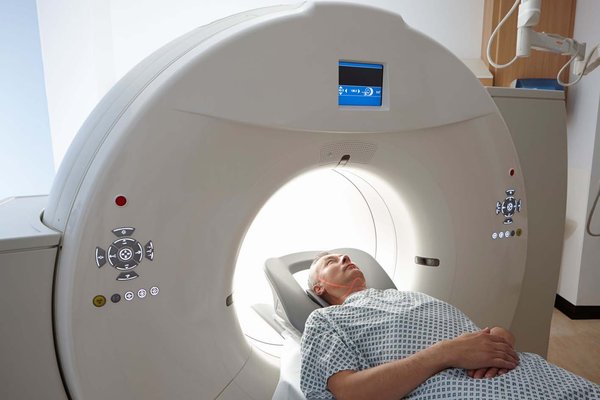
a patient undergoing a head CT scan (NHS)
Two pioneering studies in which Oxford University Hospitals (OUH) researchers are playing leading roles have received funding from the National Institute for Health and Care Research (NIHR) as part of an £8 million initiative to support artificial intelligence (AI) projects designed to reduce NHS waiting times and improve patient care.
These two studies - SAMURAI-CT, led by the OUH-based Oxford Clinical Artificial Intelligence Research (OxCAIR), and SMART-XR, for which OUH serves as the lead site and sponsor - form part of a wider Oxford-led programme that is establishing a comprehensive platform to evaluate clinical AI technologies that could be adopted by the NHS.
The SAMURAI-CT study (award NIHR504861) will evaluate AI-assisted interpretation of head CT scans in emergency departments, examining whether AI can help clinicians identify urgent abnormalities in the brain more rapidly, improve patient flow and reduce delays in care.
SMART-XR (award NIHR504569) explores whether AI can safely relieve clinical workload through autonomous reporting of chest X-rays.
Another project in which OUH is involved also received funding from the NIHR: SWIFT LUNG is testing an AI tool that can predict lung cancer.
Through its Invention for Innovation (i4i) programme, the NIHR awarded a total of £8,136,409 to six projects that are testing a range of AI and digital innovations to speed up diagnosis, improve patient care and make services more accessible and efficient.
Professor Lucy Chappell, Chief Scientific Adviser to the Department of Health and Social Care and CEO of the NIHR, said this backing would help “to drive the fundamental shift from an analogue to a digital health service and deliver the government’s 10-year health plan. This important investment in AI and innovation will cut NHS waiting times, fast-tracking diagnoses and ensuring patients receive more accessible, efficient, and high-quality care."
Despite rapid advances in artificial intelligence, generating robust evidence to show how AI systems perform in real-world clinical practice remains a major challenge.
To address this challenge, OxCAIR researchers and collaborators from across the NHS have established the SAMURAI (Systematic Assessment of Medical Utility of Radiology Artificial Intelligence) programme, a coordinated portfolio of studies designed to evaluate AI technologies across the entire clinical translation pathway.
Dr Alex Novak, Co-director of OxCAIR, said: “The studies we are undertaking look at all aspects of the use of AI in healthcare – from establishing the necessary ethical, governance and data infrastructure, to evaluating how AI affects the performance of clinicians or assessing the real-world clinical impact of AI systems in routine practice.
“Together, they will provide a comprehensive framework for generating the evidence required for the safe, effective and scalable adoption of AI across healthcare. They will also explore how AI can be used not simply as a diagnostic tool, but as a means of transforming clinical workflows and expanding healthcare capacity.”
A flagship study within the SAMURAI-Pro platform is SAMURAI Fracture, currently underway across multiple NHS sites. The study is evaluating whether AI can assist clinicians in identifying fractures on radiographic imaging, supporting more accurate and efficient diagnosis in emergency care settings.
The newly funded SAMURAI-CT study represents the next stage of this work. The project will evaluate AI-assisted interpretation of head CT scans in four NHS emergency departments, examining whether AI can help clinicians diagnose urgent intracranial pathology more quickly and accurately and so cut discharge times. As well as OUH, the study is being carried out at Royal Berkshire NHS Foundation Trust, University Hospitals of Derby and Burton NHS Foundation Trust and Greater Glasgow and Clyde Health Board.
The Oxford-led programme is uniquely positioned to evaluate the full spectrum of AI deployment models within healthcare: SAMURAI Fracture examines how AI can assist clinicians, providing support for decisions, while retaining clinician oversight; SAMURAI-CT evaluates how AI may augment and extend clinical expertise, enabling clinicians to make faster and more informed decisions when interpreting complex imaging.
SMART-XR, which is being carried out in partnership with the medical technology company Harrison-AI, explores the next frontier: whether AI can safely and practically report chest X-rays autonomously. Using a carefully set clinical threshold, it will identify which scans AI can handle, aiming to reduce radiologists’ workload and cut reporting delays across the NHS. The evaluation will compare AI reviews of 12 months of chest X-rays from OUH and Manchester University NHS Foundation Trust and test for accuracy. The study will help to determine how best to deploy AI screening alongside human expertise, and potentially to address one of the largest bottlenecks in diagnostic imaging pathways.
Dr Alex Novak, Co-director of OxCAIR, said: "Artificial intelligence has shown considerable promise in diagnostic imaging, but robust real-world evaluation is essential before these technologies can be adopted at scale. This NIHR investment recognises the importance of generating high-quality evidence on how AI can improve both patient outcomes and healthcare efficiency. We are delighted that Oxford will play a leading role in this national programme."
Dr Sarim Ather, Co-director of OxCAIR added: "Healthcare AI has reached a critical point. The key question is no longer whether these technologies can detect abnormalities in research environments, but how they should be integrated into routine clinical care.
“Through the SAMURAI programme and our national collaborations, Oxford has developed an evaluation framework that spans the entire pathway from validation to implementation. The NIHR's support enables us to generate the robust evidence needed to determine where AI can assist clinicians, where it can extend their capabilities and where it may ultimately be able to undertake tasks autonomously while maintaining safety and quality of care."
The SWIFT LUNG study, which is being led by NHS Greater Glasgow and Clyde, is testing an AI tool developed by the University of Oxford spin-out company Optellum to improve care for people with lung nodules. It predicts lung cancer and provides a patient safety net. The study will see if it can speed up scan assessments, reduce waiting times, support consistent care decisions, improve patient follow-up and cut healthcare costs. It is being trialled in three NHS sites: NHS Highlands, NHS Greater Glasgow and Clyde and Oxford University Hospitals NHS Foundation Trust.