Seed money helps transform services at OUH
09 October 2026
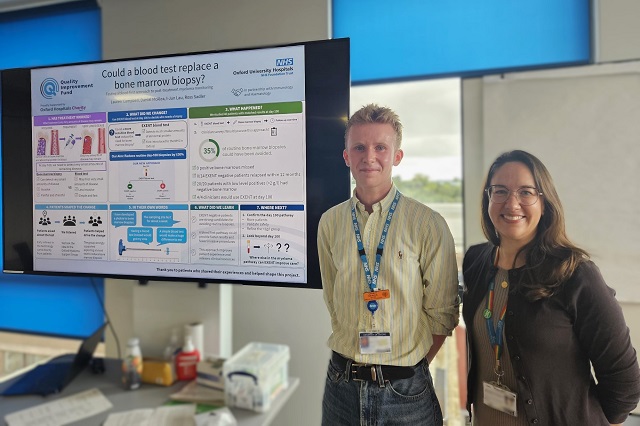
Danny McAlea and Lauren Campbell
Earlier this year OUH staff were invited to share their ideas for how funding of £5,000 could bring positive change to their hospital areas. The Quality Improvement (QI) scheme was seeking small-scale, but big impact projects with creative, patient-focused ideas to address healthcare challenges in new ways.
Of the 152 bids received, ten were awarded a grant. Projects included: improving support for children and families after cancer treatment; group-based patient education in Ophthalmology; bringing in 'All about me' patient boards to Paediatric Critical Care; strengthening teamwork in the Ambulatory Assessment Unit and establishing a dedicated Pleural Service at the Horton General.
In September Oxford University Hospitals held a day-long showcase for some of the successful projects that, with the support of Oxford Hospitals Charity, staff have been working on. Oxford Hospitals Charity provided £50,000 to support the ten QI projects that took place.
Jamie French, Interim Head of Programme at the Charity said: "We are thrilled to see how our charity's funding has enabled such innovative work to take place across our hospitals through this new scheme. Hearing staff talk with such passion and insight about their findings and breakthroughs was just wonderful, and we're excited to see the difference these projects will make for patients in our hospitals."
Felicity Taylor-Drewe, Chief Operating Officer said: "Our Trust is committed to quality improvement, based on the experiences of our staff. This is a way of driving up excellence through everything we do, putting the patient experience at the heart of these changes. We also firmly believe that improving quality saves money and improves staff experience. It was brilliant to hear about the many QI projects that are going to drive real improvements to services.
"I would like to thank our QI team for supporting the project teams and for putting on an excellent event, and Oxford Hospitals Charity for their financial support which enabled this to happen."
Case Study
One project asked the question: "Could a blood test replace a bone marrow biopsy?"
Bone marrow biopsies are difficult to do, unpleasant for the patient, samples are difficult for the labs to work with, and they are expensive.
Clinical Scientist in Immunology, Lauren Campbell, worked on this project alongside fifth year medical student from the University of Oxford, Danny McAlea.
They worked with the Myeloma Support Group to develop the QI project, hearing about the patient's experience of regular bone marrow biopsies. Patients were enthusiastic about the possibility of being able to reduce the numbers.
Lauren Campbell, Immunologist said: "We are really grateful to this fantastic group of patients, who helped shape the project from the outset. Their input helped us understand what matters most to people living with myeloma and how this technology could be used to improve their care.
"Our next step is to make the case to bring this work into routine clinical practice. This project has also highlighted that there are many opportunities to use this technology across the myeloma pathway."
Danny McAlea said: "It has been incredible to work on a project which bridges research and quality improvement with clinical practice, and which has so much potential to improve patient experience. This technology is really exciting and could represent a step-change in how we monitor myeloma in the years to come."
The ultimate findings of the QI project were that for these follow-up tests, biopsies should be able to be reduced by 35% - it is a reduction rather than a total removal of the process at this stage, but still welcome in improving the experience of patients and staff as well as saving time and money.