Two healthcare scientists receive national funding for research projects
07 October 2026
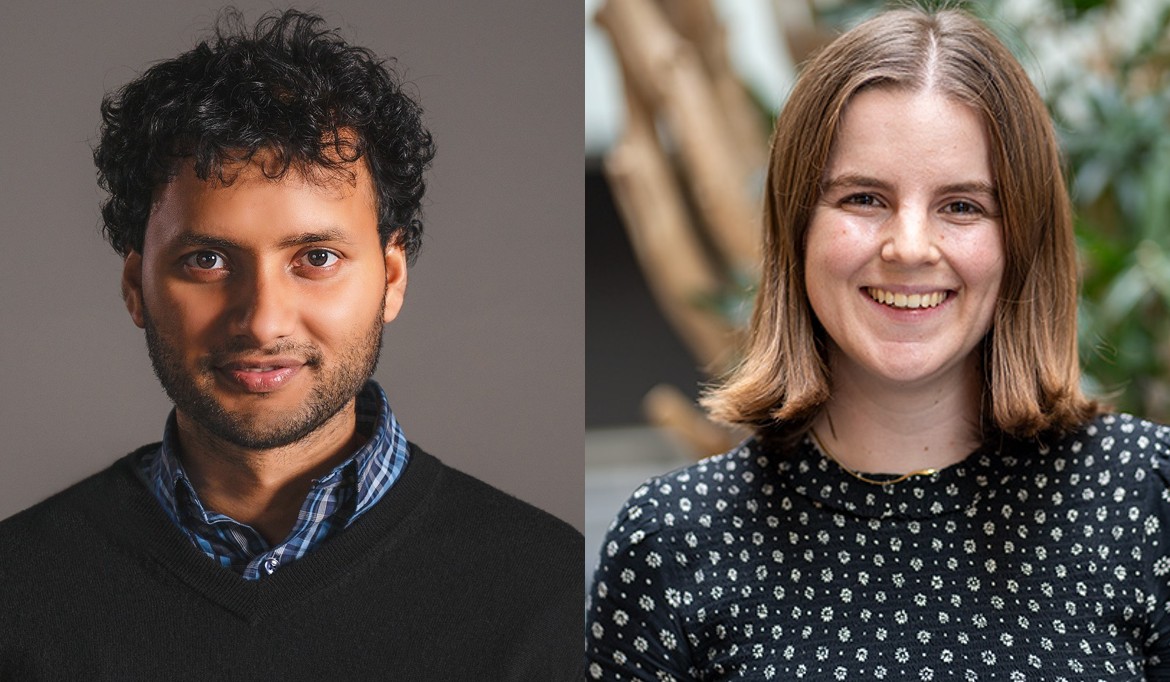
Healthcare Scientists Pratik Samant and Lara Bonney
Two Oxford University Hospitals (OUH) healthcare scientists have been awarded national funding for research projects that will directly benefit patients and improve NHS services.
Principal Clinical Scientists Pratik Samant and Lara Bonney have been awarded three-year grants by the National Institute for Health and Care Research’s (NIHR) Research for Patient Benefit (RfPB) Programme, which is aimed at early career researchers and health and care professionals working in the NHS.
Healthcare scientists are underrepresented in research and Pratik and Lara are among the first healthcare scientists at OUH to receive NIHR RfPB awards.
Lara, a Medical Physicist who helps to support all the nuclear medicine departments across OUH, said: “On a personal level, it’s really exciting. This is the kind of research we couldn't do without that funding for my time. It gives us the opportunity to expand and press ahead with projects where we have done some initial feasibility work and believe it could have real benefits. That wouldn’t be possible with our normal clinical pressures. It’s also nice opportunity to remind people that healthcare scientists are here and show them the kind of work we do.”
Pratik, a Principal Clinical Scientist in Research and Education, said: “It’s very exciting to receive this funding, as it’s been difficult in the past for healthcare scientists to obtain research funding. This NIHR research grant buys our time from the NHS so that our role can be back-filled, and this has been enormously helpful in allowing me to explore my research interests as a clinical scientist.”
Pratik’s project will be focused on radiotherapy. It seeks to address a situation where a patient’s cancer returns and requires radiotherapy – and they have had this treatment previously. Pratik is aiming to develop software that can more accurately calculate the radiation doses from the two rounds of radiotherapy by aligning CT scans more precisely. Getting the second dosage right is important because patients may be at risk of side effects and potentially damaged organs if the two doses are not calculated accurately.
Unlike current practice, the software will take account of any changes in the patient’s body and internal organs over time by adjusting one CT scan to fit the other before adding the doses together.
“We expect that this approach will improve radiotherapy treatment planning and help clinicians to deliver the right total dosage of radiation and so avoid the risk of damaging healthy organs,” Pratik said, explaining that former radiotherapy patients had had input into his submission and would be consulted regularly throughout the project.
Lara’s project aims to improve how PET/CT scanners are checked. These scans, which are important in cancer care, take a long time relative to other imaging and are in great demand. However, because accuracy is vital, these scanners have to be taken out of use for regular quality checks, which can delay patient appointments.
Lara will use artificial intelligence to check the quality of scans after each patient, rather than relying only on scheduled checks that interrupt clinical work. The AI will be trained on 20,000 existing scans from a wide range of patients, helping it to learn what makes a ‘good’ scan. Patient data will be kept secure.
If successful, this approach could help staff spot problems with the scans immediately, so scans can be repeated the same day if required, reducing delays for patients. It should also increase the number of cancer patients who can be seen.
“If we reduce unexpected problems with these scanners, we’re hopeful it could help our trust - and the wider NHS – to use this vital equipment and staff resources more efficiently, as well as improving the accuracy of diagnoses for our patients. If this project is successful, I hope that one day this approach will be standardised and implemented across the country, and perhaps even adopted to improve quality checks for other types of medical imaging.”
Associate Professor Daniel McGowan, Head of Education and Research, in OUH’s Department of Medical Physics and Clinical Engineering, was a co-applicant on Pratik’s submission and is the senior Principal Investigator supporting Lara’s project. He said: "Huge congratulations to Lara and Pratik on receiving these competitive awards. These grants will help develop them as clinical academics at OUH, as well as producing outputs that will benefit patients.
“It is wonderful to see healthcare scientists recognised and supported in this way. As a professional group, they underpin 80% of all clinical diagnoses in the NHS and have a huge amount to offer on the research side too.
“I'd also like to thank the patients who helped developed these research proposals and who are going to be involved as the projects develop."