OUH expands cardio-oncology project as part of major European initiative
20 April 2026
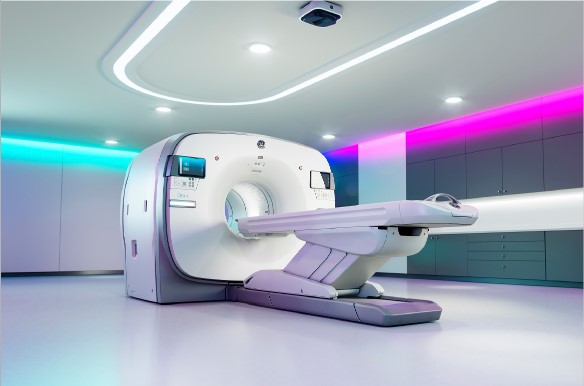
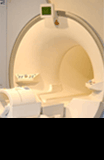
A GE HealthCare PET scanner
An Oxford University Hospitals (OUH) expert is playing a key role in a major European project looking at how innovative medical and digital technologies can improve the early detection of heart-related problems in cancer patients and survivors.
Professor Daniel McGowan, Head of Education and Research in the Department of Medical Physics and Clinical Engineering, will lead the Oxford part of the project in collaboration with GE HealthCare. They will be looking at how they can adapt routine PET scans to also assess a patient’s heart health.
The five-year COMPASS initiative is funded by the European Union under the Innovative Health Initiative (IHI), with a budget of more than €50 million, some €399,000 (£347,000) of which will come to OUH. The project, which brings together more than 60 partners from 25 countries, will carry out clinical trials and research activities focused on imaging, biomarkers and long-term patient follow-up.
While chemotherapy is an important treatment for cancer, some chemotherapy agents can damage the heart. Furthermore, cancer survival rates are increasing, and with more patients living longer, the likelihood of them developing heart problems increases.
Professor McGowan, who is also Associate Professor in the University of Oxford’s Department of Oncology, explained: “The aim is that when a person has a PET scan to check on their cancer, we could effectively give them a free heart check at the same time. With this additional information, we can stratify patients into those who need to see a cardiologist fairly urgently, those who we’d like to monitor and those whose hearts are healthy.
“Many patients have other scans or echocardiograms to check on their heart. This new approach would mean those additional tests – with the time and stress they might entail for the patient – may no longer be necessary, as the single PET scan could answer two questions at once.”
A PET (positron emission tomography) scan is an imaging test that uses a radioactive tracer that is injected into the body to highlight areas with high metabolic activity, allowing clinicians to assess at what stage cancer is or whether treatment is working.
The research that Professor McGowan is doing as part of the COMPASS trial is a continuation of the work he is already doing with Zoe Wilson a Research Scientist at OUH, who is undertaking a doctorate in the University Department of Oncology, along with colleagues in Cardiff.
The wider, Europe-wide scope of COMPASS means the team will have access to data from hospitals in Belgium, the Netherlands and Portugal. These increased data open the possibility of applying AI and machine learning to the scan to accurately identify those patients most at risk of heart problems at an earlier stage.
“This dedicated funding will enable us to expand and accelerate our efforts in this field, which should speed up the translation of our research work into clinical care, and ultimately get the benefit to patients quicker.”