Mum gives birth to baby boy following womb transplant, thanks to pioneering research programme
24 February 2026
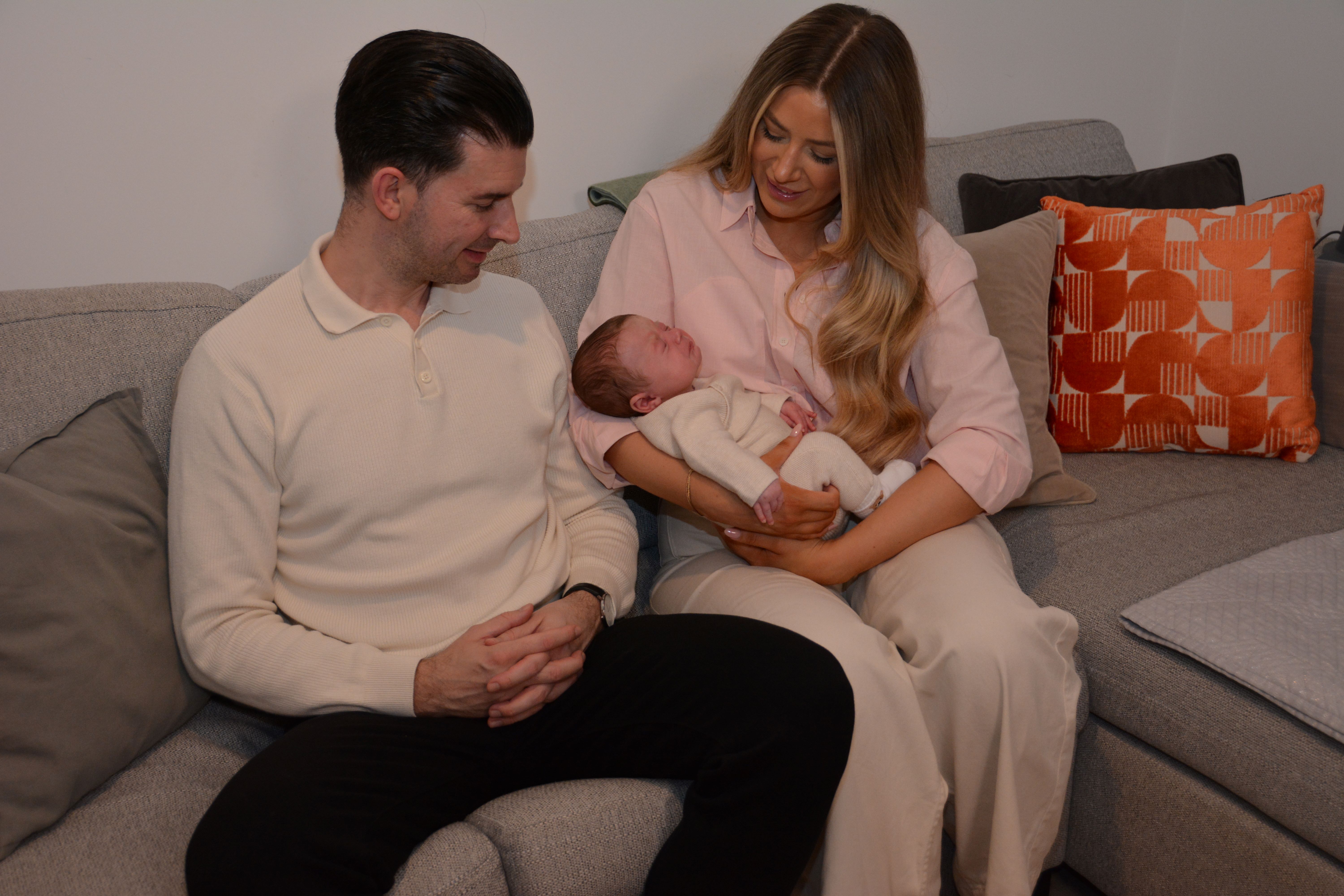
New parents Grace and Steve, with baby Hugo (image: Womb Transplant UK)
A woman in her early thirties has become just the second person in the UK to give birth following a womb transplant – and the first following a transplant from a deceased donor. Grace Bell and her baby boy, Hugo Richard Norman Powell, are both very well following a caesarean section at Queen Charlotte’s and Chelsea Hospital in London in December 2025.
Grace, who lives in southern England with her partner Steve Powell, was born without a womb. She is the first person to have a baby as part of the approved deceased donor womb transplant research programme, which was initiated and funded by the charity Womb Transplant UK and will include a total of 10 transplants.
This is a new, rare form of transplant for this research programme, approved by the UK’s Health Research Authority. It is not therefore part of routine donation and is not covered by the NHS organ donor register (ODR) or deemed consent. Each donation requires special, extra consent from families of deceased donors after the donation of other organs has already been agreed.
Grace never thought she’d have the chance to carry and give birth to her own baby and is incredibly grateful to everyone involved in the research programme, especially the deceased donor and their family for choosing to donate. She and Steve gave baby Hugo his second name, Richard, after Professor Richard Smith who founded the transplant programme. The research team believe that Hugo is the third baby born in Europe following a transplant from a deceased donor.
This happy moment came just 10 months after Grace Davidson became the first woman in the UK to give birth following a live womb transplant, after her sister Amy donated her womb. Baby Amy Isabel and Grace continue to do well.
These two milestones follow over 25 years of pioneering research and innovation involving many experts, hospitals and organisations. This has been led in the UK by Professor Richard Smith, a consultant gynaecological surgeon, and by Miss Isabel Quiroga, a leading consultant transplant and endocrine surgeon at Oxford University Hospitals. The team have two programmes, both funded and supported by the charity Womb Transplant UK.
The first is a living donor programme, planning for five transplants. Each donation is considered by the Human Tissue Authority (HTA) and only once HTA approval is in place can a donation proceed. The second is the UK Investigational Study into Transplantation of the Uterus (INSITU) research programme involving deceased donors.
The INSITU research programme combines expertise from Imperial College Healthcare NHS Trust, Oxford University Hospitals (OUH) NHS Foundation Trust, NHS Blood and Transplant, Womb Transplant UK and The Lister Hospital, part of HCA Healthcare UK. The clinical team give their time free of charge, with Womb Transplant UK funding the cost of the transplant operations and associated treatments (£30,000 for each) that take place largely in NHS facilities to ensure there is no financial burden on the NHS.
How it happened
NHS Blood and Transplant Specialist Nurses discussed the option of womb donation for this research programme with the donor’s family, once they had already agreed to organ donation through the usual process. The donor family have since expressed "tremendous pride at the legacy" their daughter leaves behind, at how "she has given other families the precious gift of time, hope, healing and now life". Like them, NHSBT report the great majority of families asked so far about the extra option of womb donation have supported donation, although the medical complexities of the programme mean this is the first birth.
The subsequent implant took just under seven hours. Grace then had IVF treatment and embryo transfer at the Lister Fertility Clinic in London. She has since been closely monitored at OUH's Churchill Hospital and at Queen Charlotte’s and Chelsea Hospital, which is run by Imperial College Healthcare and is where baby Hugo was born.
A history of breakthroughs
One in 5,000 women in the UK are born without a viable womb and are unable to conceive and carry their own child. Many other women lose their wombs as a result of cancer or other medical conditions. There have been over 100 womb transplants worldwide and more than 70 healthy babies born so far.
This latest birth follows over 25 years of womb transplant research in the UK, which had already led to the development of a number of other surgical procedures. This includes the development of the abdominal radical trachelectomy, which has enabled fertility preservation of many thousands of women with early-stage cervical cancer, and the modified Strassman Procedure, which has been used to preserve the reproductive potential of women with placental site tumours, and other conditions.
The new mother, Grace Bell, said: “There are no words to say thank you enough to my donor and her family. Their kindness and selflessness to a complete stranger is the reason I have been able to fulfil my lifelong dream of being a mum. I hope they know that my child will always know of their incredible gift, and the miracle that brought him into this world. I think of my donor and her family every day and pray they find some peace in knowing their daughter gave me the biggest gift, the gift of life. A part of her will live on forever.
“I also want to express my deepest thanks to the clinical teams who have supported me throughout this journey. There are so many people to thank — from the initial transplant, transplant aftercare, embryo transfer, maternity care, and delivery, all the way to now. I am in awe of their teamwork, dedication, and belief in me, especially when I never thought this outcome was possible.
“My hope is that one day this option to motherhood will become much more accessible, so others may have the same chance I have been given.”
The parents of the donor said: “Losing our daughter has shattered our world in ways we can barely put into words. The grief is overwhelming, and the ache of her absence is something we will carry forever. Yet even in this unimaginable pain, we’ve found a small measure of solace in knowing that her final act, her choice, was one of pure generosity. Through organ donation, she has given other families the precious gift of time, hope, healing and now life.
“As her parents, we feel tremendous pride at the legacy she leaves behind — a legacy of compassion, courage and love that continues to touch lives even after her passing. We urge others to consider donation, so that more people in desperate need may be given the chance to live, just as our daughter so selflessly wished.”
Professor Richard Smith co-leads the UK womb transplant research team. He is founder and chair of the charity Womb Transplant UK, a consultant gynaecological surgeon at Imperial College Healthcare NHS Trust and professor of practice at Imperial College London. He said: “I’m so happy for Grace, Steve and their family. It was just wonderful to be there at the birth and to see baby Hugo coming into the world, after our journey with this family and the many years of research that led us to this moment.
“This was only possible thanks to the generosity of the donor family for deciding to donate, following the tragic loss of their own daughter. This decision ultimately led to the birth of a healthy baby boy. I will be forever grateful to them, as well as to every family who has supported our programme to date.
“I would also like to thank our dedicated and experienced team of doctors, surgeons and nurses, who brilliantly supported our patients and family members through each step of the journey. We are very fortunate that our work is funded by the charity Womb Transplant. With the continued generosity of the charity’s supporters, we hope to be able help more women soon.”
Miss Isabel Quiroga co-leads the UK womb transplant research team and Womb Transplant UK charity, alongside Professor Richard Smith. She is a consultant transplant and endocrine surgeon and clinical lead for organ retrieval at OUH's Oxford Transplant Centre. Isabel said: "This is a huge milestone, giving more hope to women who do not have a womb and are looking to start a family. This is the only treatment that gives them the ability to carry and give birth to their own child, offering another option alongside adoption or surrogacy.
"Grace is a truly courageous and caring person. I'm just delighted for her and her partner Steve. I would like to thank the donor family for their generosity and compassion. The decision to donate their daughter's organs saved multiple lives. In deciding to also then donate her womb, they have also helped to create a new life. This is extraordinary and we now have a healthy baby boy."
Miss Bryony Jones is a consultant obstetrician and fetal and maternal medicine specialist at Imperial College Healthcare NHS Trust, who is also part of the UK womb transplant team. Bryony and her team cared for Grace during her pregnancy and led the delivery of her baby. She said: “It has been such an incredible journey for all of us and I am delighted for Grace that all has gone smoothly and to a wonderful outcome, with a beautiful baby boy.
“A big thank to all the maternity, medical, anaesthetic and neonatal staff at Queen Charlotte's and Chelsea Hospital for their tremendous efforts and expertise - and to our wider womb transplant team. I feel incredibly fortunate to work with so many dedicated and brilliant people".
Becky Clarke, who leads the NHS Blood and Transplant nursing team working on consenting families to donate, said: “We congratulate mum Grace and baby Hugo and everyone involved but we especially thank the incredibly generous donor family who decided to donate their daughter’s womb into this research programme.
“If you join the Organ Donor Register or agree to normal donation, it does not cover womb donation. In this programme, NHSBT’s specialist nurses in organ donation seek an extra consent from families who have agreed to normal donation. Only a very small numbers of donors will be eligible and will be approached about this form of donation.
“Donation is about choice, and this research programme increases the choices available to some families who have already agreed to donate other organs. We hope it will be life-changing and life-creating for the people who choose to take part. We are very grateful to any families who choose to give the additional consent for donation to this programme.”
Mr Benjamin Jones, consultant gynaecologist and fertility specialist at the Lister Fertility Clinic and assistant director of Womb Transplant UK, said: "I am absolutely delighted to have supported Grace and Steve through their fertility treatment following Grace’s uterus transplant, leading to the first successful live birth after a deceased-donor uterus transplant, made possible by years of clinical innovation and the extraordinary generosity of the donor and their family.”