Treatment of tumours with sound: new high-intensity focused ultrasound machine installed
02 February 2026
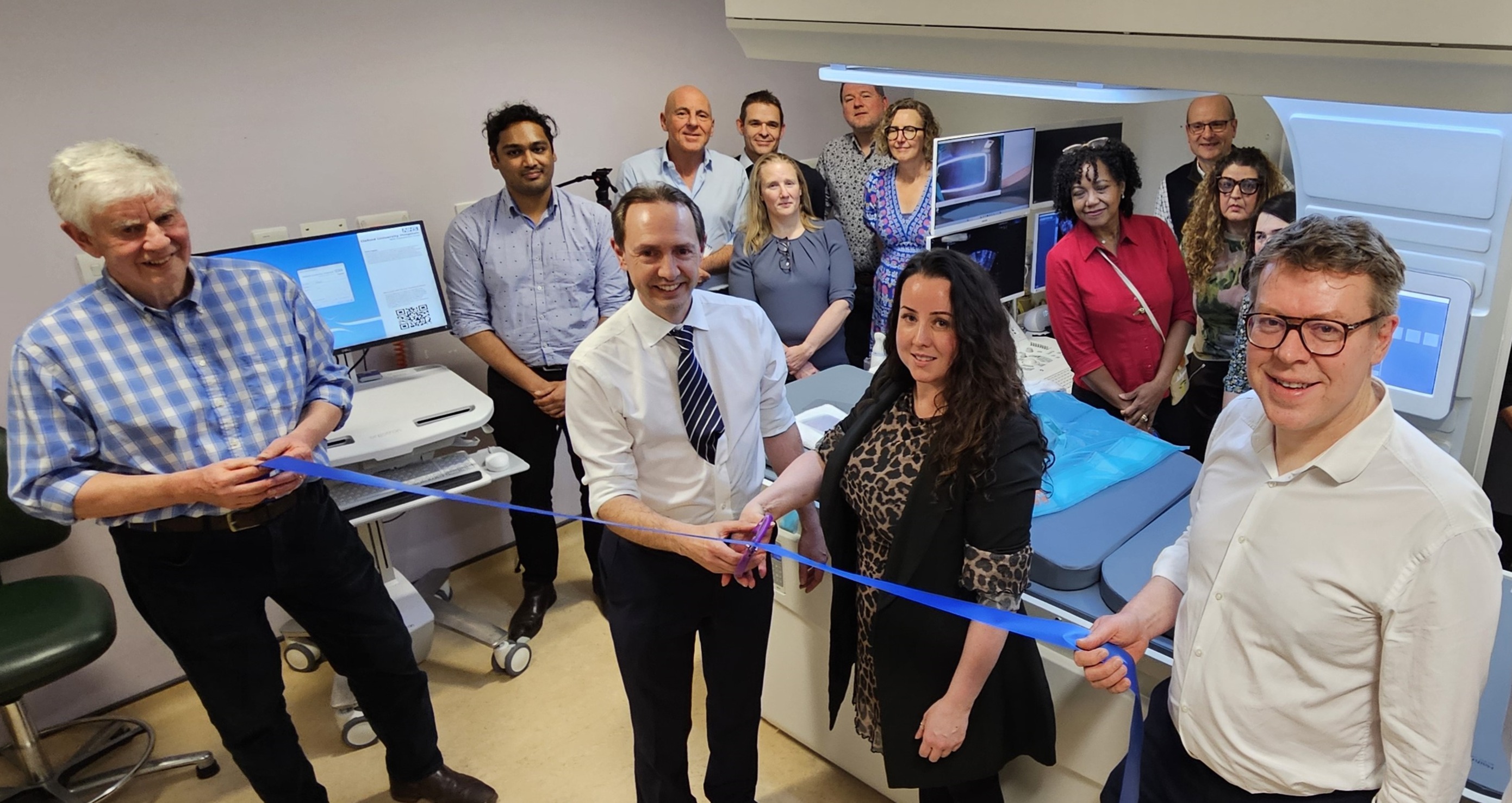
Those attending the event to mark the unveiling of the new HIFU machine included (foreground, left to right) Professor David Cranston, Dr Rustam Rea, patient Estella Devaney Fenn, and Dr Paul Lyon.
A new state-of-the-art high-intensity focused ultrasound (HIFU) machine has been installed at the Churchill Hospital, giving Oxford University Hospitals (OUH) cancer patients access to the latest in this innovative technology.
HIFU is a non-invasive treatment that uses ultrasound to heat and destroy targeted tumour cells. It is regarded as an emerging and versatile tool to tackle some solid cancers and non-cancerous tumours.
The device is ultrasound-guided and works to target organs inside the body completely non-invasively using only the power of sound, without the need for radiation.
Studies in some conditions have found that outcomes for patients with HIFU are similar to surgery with faster recovery and fewer adverse effects.
The new machine was officially unveiled at a ceremony at the Churchill Hospital radiology department by Dr Rustam Rea OUH Deputy Chief Medical Officer and Director of Clinical Improvement.
In Oxford, designated a Focused Ultrasound Centre of Excellence in 2023, an earlier version of this device has been used for clinical indications such as fibroids and adenomyosis, both conditions that affect the uterus and can cause pain and heavy periods, as well as in research trials to treat cancers of the kidney, liver and pancreas.
This new machine will allow the OUH team to continue to expand the clinical programme in the treatment of non-cancerous tumours, including uterine fibroids, in addition to developing further research programmes potentially involving cancers of the breast and musculoskeletal system, such as sarcoma.
The new JC200, CE-marked for tumour therapy, was gifted to OUH by the Chinese manufacture, Haifu Technology Ltd, and replaces a similar but older HIFU machine which had been installed in 2010 and was used to gain CE-marking for the device but which was reaching the end of its life.
Charitable donations, including funds from the Focused Ultrasound Foundation, have helped cover the installation and maintenance costs of the new device.
Professor David Cranston, Emeritus Clinical Director of HIFU, said: “This technology holds enormous promise for greater clinical expansion, as well as further research. Studies in fibroid patients have shown that outcomes with HIFU are similar to surgery with faster recovery and fewer adverse effects.”
Dr Paul Lyon, OUH Consultant Radiologist and Clinical Director of the Oxford HIFU service, said: “This upgrade is fantastic news for our patients. The improved technology in the latest JC200 device means treatments can be quicker and smoother for the patients. It’s a major upgrade in terms of both diagnostic and therapeutic performance. In addition to enabling expansion of the existing clinical service it also offers great potential for cutting-edge oncology clinical research.”
Dr Rustam Rea, OUH Deputy Chief Medical Officer and Director of Clinical Improvement, said: “This is an exciting opportunity to provide excellent clinical care to our patients with the latest technology. It is great to see the collaboration between OUH, the University of Oxford and the manufacturer to enable delivery of this innovative service.”
Professor Feng Wu, OUH HIFU Consultant, said: “Not only can the device continue to treat the types of tumours we have done before, the new machine is capable of treating more superficial tumours such as breast tumours, because of the improved range of treatment transducers and ultrasound imaging quality.”
Prof Constantin Coussios, Co-Director of the Focused Ultrasound Foundation Centre of Excellence with Dr. Paul Lyon, said: “Working closely with the Institute of Biomedical Engineering, University of Oxford, there is a wealth of leading-edge clinical research that could be done on the JC200 and this is not limited to thermal ablation. Different focused ultrasound treatment effects can include gentle heating or excitement of tiny bubbles inside cancerous tumours, leading to improved drug delivery and immune system stimulation.”