‘Ground-breaking’ digital advance for mouth cancer patients
08 December 2025
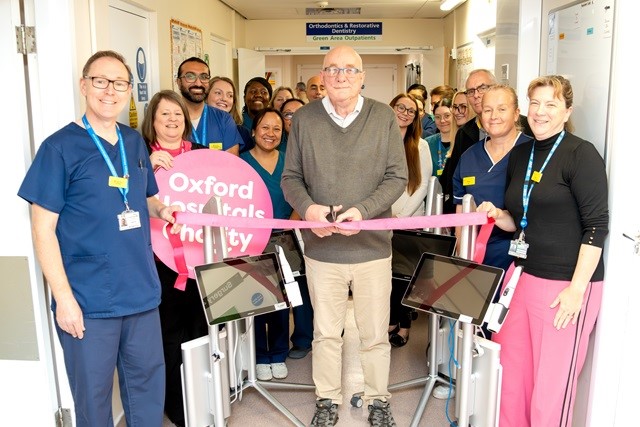
Patient Gregory Head cut the ribbon and described the new equipment as "ground-breaking"
The Restorative Dentistry, Maxillofacial Surgery and Orthodontic team at the John Radcliffe Hospital has celebrated a major advance for patients needing reconstructive care for mouth cancer surgery, trauma and craniofacial conditions.
A ribbon cutting ceremony at the hospital, part of Oxford University Hospitals NHS Foundation Trust (OUH), brought patients, staff and members of the Oxford Hospitals Charity team together to mark the occasion.
Gregory Head, a head and neck cancer patient from High Wycombe, who cut the ribbon, described the new equipment as "ground-breaking" and "a huge improvement for patients".
Over £170,000 of state-of-the-art 3D imaging and printing equipment has been funded by Oxford Hospitals Charity to fully digitise processes to scan and reconstruct parts of the mouth and face.
The new techniques are less painful and distressing for patients, as well as quicker and more precise.
The processes are also more environmentally friendly and will save the NHS the costs of storing thousands of physical plaster of paris moulds for many years.
OUH has the largest maxillofacial centre in the UK and is one of the first working in this fully digitised way.
Paul Wilson, the Clinical Lead for Oxford Maxillofacial Surgery, Orthodontics and Restorative Dentistry (OMFSORD) at OUH, said: "We're thrilled to be leading the way with this advanced technology and have already had such a positive response from our patients.
"Mouth cancer is the sixth most common cancer in the UK, and we see thousands of patients from across the south every year.
"Traditionally the methods used to 'map' the mouth and face for rebuilding and reconstruction following the removal of tumours have been intrusive and uncomfortable, with wet moulds inserted inside the patient's mouth and nose cavities.
"This can be distressing and painful for some of our patients as well as a time-consuming procedure, that also uses up a lot of resources. So we are thrilled to have moved things forward in such a positive way, thanks to the support of our hospital charity."
The process to create an exact image of the area that needs to be reconstructed is now all done digitally, using wand-shaped scanners to map the mouth with extraordinary accuracy funded by the charity.
These digital images are then transformed using 3D printing into the required physical plates to perform the reconstruction and rebuild the damaged area.
The new technology, which is far more precise than the old techniques, can also be used with other head and neck cancer patients, those with craniofacial conditions and patients who have had a traumatic injury to the face.
Paul Wilson said: "This is highly specialist care for a range of very complex conditions, and we are thrilled to have transformed the service for our patients.
"It's been a huge team effort and I am incredibly proud of everyone who has worked so hard to make this happen and also very grateful indeed to our friends at Oxford Hospitals Charity and their donors who have funded all of this new technology."
Felicity Taylor-Drewe, Chief Operating Officer at OUH, said: "It's been great to meet the team and their patients and hear first-hand how passionate they are about this pioneering work. As well as being great for patients, this advance brings real environmental benefits and NHS savings as the costs of creating and then storing traditional plaster moulds will no longer be needed.
"Many congratulations to all who helped make this possible, and also a huge thank you to our hospital charity for such special support."
Douglas Graham, CEO of Oxford Hospitals Charity, said: "We are delighted to hear that our funding of four oral scanners and a specialist 3D printer has helped the team to be one of the most advanced centres in the UK for this specialist care. The benefits to patients are very clear indeed and this an exciting step forward that we are proud to be part of."